Why we built a deterministic PTP analysis engine for private fund transfers
When a limited partner asks to sell its interest in a private fund, it requires the general partner’s consent. Before granting it, the general partner must assess the tax consequences of the transfer under the U.S. publicly traded partnership (PTP) rules. Many private funds rely on a regulatory safe harbor that limits non-exempt transfers in a tax year to 2% of partnership capital or profits. Exceeding that threshold means the 2% safe harbor is no longer available, which can expose the fund to corporate-level tax on investment returns if no other exception applies.
Every transfer that closes during the partnership’s tax year counts toward the threshold unless a regulatory exclusion applies, so the general partner must evaluate each request against both completed transfers and pending transactions still in progress. A transfer that appears compliant in isolation can push a partnership past the 2% limit when combined with other activity. Yet most managers and their counsel still track that running total across email threads and manually updated spreadsheets.
In practice, the parameters of an LP transfer frequently shift before closing. A buyer may split the interest across multiple acquiring vehicles, a seller may adjust the transfer amount shortly before closing, or a target December effective date may slip into January. Every adjustment to the parties, interest transferred or closing date requires a fresh calculation and additional legal review on what is meant to be a routine transaction. Without a live system, the general partner risks consenting based on an outdated picture.
We built the PTP analysis engine in Navys so the general partner and its counsel work from a single, live record of every closed and pending transfer. Because Navys combines fund administration with legal workflow, the authoritative investor register and active transfer requests live on the same platform. For each partnership, the engine combines settled transfers from the current tax year with pending transfers based on their latest deal terms, measuring the projected total against the 2% safe harbor. The calculation is deterministic: identical inputs always produce the same result, and every percentage is traceable to the underlying transfer records.
Two transfers can each stay within the 2% limit and exceed it together
Secondary sales can bring a fund within the PTP rules even when its interests are never listed on an exchange. Exceeding 2% in a tax year does not automatically classify a fund as a PTP, but it removes the 2% safe harbor and requires further legal analysis by tax counsel.
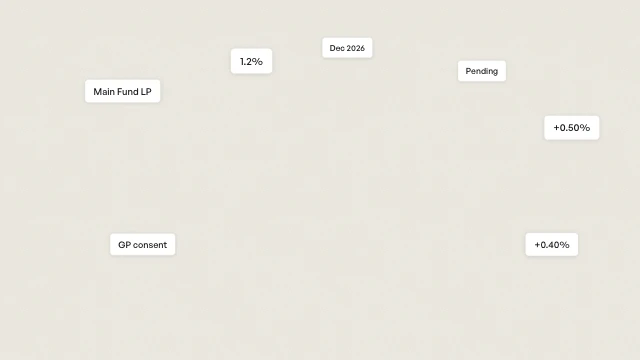
Take a hypothetical fund that relies on the 2% safe harbor, where tax counsel has confirmed which transfers count toward the limit:
| Transfers this tax year | % of partnership interests |
|---|---|
| Closed transfers that are not exempt | 1.2% |
| Pending transfer A | 0.5% |
| Pending transfer B | 0.4% |
| Total if both close this year | 2.1% |
Adding Transfer A to the closed transfers produces a total of 1.7%, while adding Transfer B in isolation produces 1.6%. If both pending transfers close in the same tax year, however, the total reaches 2.1%, exceeding the 2% safe harbor.
While a general partner generally has visibility across the pipeline of transfer requests, transactions progress at different speeds and expected closing dates often shift. That makes it difficult to evaluate a transfer that is ready to close today against other pending transfers that may or may not close before year-end. Seeing the combined projection upfront allows the general partner to coordinate closing dates with the investors or seek tax advice before granting consent.
How we built the engine
The calculation runs at the vehicle level
A single LP transfer request often spans multiple vehicles within the same fund structure, such as a main fund, parallel funds or feeder vehicles. A blended figure across the whole fund would obscure how much of each vehicle’s 2% safe harbor capacity has been used. Because the PTP rules apply separately to each entity treated as a partnership for U.S. tax purposes, we built the engine to calculate safe harbor capacity at the individual vehicle level, pulling directly from the specific interests being transferred, the fund structure and the investor register in Navys.
The projection updates automatically as transaction terms change
Traditional fund administration records reflect a transfer only after it settles, while legal workflows track transactions still under negotiation. Navys unifies both, so the projection captures every closed and pending LP transfer for the relevant tax year on a single source of truth.
If a seller adjusts the transfer amount, a buyer changes its acquiring entities or an expected closing date shifts, the projection updates automatically across every affected vehicle without anyone exporting cap tables or circulating a new spreadsheet. In our example, moving Transfer B’s closing date into the following tax year immediately reduces the current year’s projected total from 2.1% to 1.7%. When a pending transfer closes and settles on the register, the engine updates its lifecycle status automatically so the same transaction is never counted twice.
A transfer’s description does not settle its tax treatment
The Treasury regulations exclude specific categories of transfers from the 2% calculation, including transfers at death, certain family transfers, carryover-basis transfers and qualifying block transfers. Whether an exclusion applies depends on the underlying facts and tax structure, not on how the investor describes the transaction.
A transaction described as an “affiliate transfer”, for instance, may satisfy a consent provision in the partnership agreement without resolving its treatment under the PTP rules. Two affiliate transfers can have completely different outcomes under the 2% safe harbor depending on the tax classification of the entities involved and whether U.S. tax ownership changes.
Our lawyers and engineers therefore designed the data model in Navys to decouple how a transfer is described commercially and under the LPA from how it is classified for U.S. tax purposes. For each leg of a transaction, the platform records the investor’s stated purpose alongside the specific regulatory basis for including or excluding it, treating pending transfers conservatively in the 2% projection until tax counsel confirms an exclusion applies.
Deterministic code for the calculation, AI for the workflow
A tax safe harbor calculation must be reproducible and auditable. Language models are probabilistic, and a figure that determines whether a fund vehicle stays within its tax safe harbor cannot be “probably right”. We built the core PTP calculation entirely in deterministic code. Once the transaction parameters and tax classifications are set, the engine applies fixed rules to produce the exact same result every time. No language model ever generates or estimates the percentages.
Every projected figure is also fully traceable. A general partner or tax lawyer can click into any percentage to inspect the exact LP transfer records contributing to that vehicle’s annual total. Because the rules are deterministic, our team continuously verifies the engine against worked examples with known outcomes.
Sam, our AI associate for fund operations, supports the workflow surrounding the calculation. Sam reads incoming transfer documents and correspondence, structures the transaction file and tracks outstanding items across the deal. When summarising a transfer request, Sam pulls the exact figures from the deterministic engine, presents them alongside the legal context, and prompts tax counsel and the deal team for confirmation before the general partner grants consent.
A shared, real-time view before consent is granted
LP transfers are supposed to be straightforward transactions with predictable legal and administrative costs, yet a miscalculation under the PTP rules carries consequences for the entire fund. By connecting the live investor register directly to the transfer workflow, Navys removes the manual reconciliation that makes safe harbor tracking so slow and expensive.
Tax counsel retains full control over how each transfer is classified, the general partner retains control over consent, and the platform handles the cross-vehicle math in real time. Instead of discovering a safe harbor issue at the eleventh hour, the team can spot capacity constraints early, coordinate closing dates with investors and keep secondary transfers moving smoothly.
Book a demo to see how Navys handles LP transfers and PTP analysis.